
QR14 Sala La Nova (The New Room)
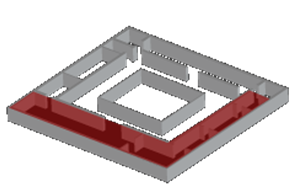 The Sala La Nova (The New Room) is located on the main floor in the east and north sections of the castell. This room features two artistic elements with a special value which belong to the original decoration, such as: the artesonados (coffered wood ceilings) and the pavimentación cerámica (ceramic floor tiles).
In the 16th century, this room housed the private quarters of the Pardo de la Casta family as well as two large salons which were used as dining rooms. Today, it is the most important premises of all the exhibition rooms because it has exhibited the most outstanding art collections that have been displayed in our castell.
This level contains the most complex artesonados (coffered wood ceilings) of the castell. These decorative elements are outstanding due to the quality of their execution, creating an effect of depth in the “casetones” (coffer ceiling sections) and in the diverse Renaissance geometric compositions.
The entry to the New Room is framed with an arco conopial de piedra (stone Ogee arch), comprised by fine and narrow carved columns. There is a small space in its interior where the Palace’s silverware and dishes were kept. Likewise, it has large windows with wood doors on the right side and in front of the entry. On the left, there is another wood door which connects to what was a large salon.
Ceramic tiles from the 18th century with the freehand technique were used in the floor of this room. The composition is formed by four square terracotta floor tiles assembled in a rhomboid shape and there is a ceramic tile with an ornamental plant motif in the centre. It depicts a yellow flower and another two flowers in the form of blue “campanillas” (morning glory) with three stems and this representation is completed with flowers and small leaves. The floor does not coincide with the monument’s construction.
This is the only small space which did not use a wood coffered ceiling; it has a white stucco roof and on the sides which enclose the room, it has notched moulding on a border with decorative motifs. It is comprised by an entangled grape vine, with its typical leaves and grape fruit, next to a series of cherubs. The drawings are highlighted with a white colour on a grey background.
From the previous space, we access the room with the largest dimensions of this level, in the corridor attached to the façade.
An element which can pass unperceived in this large room and which has been conserved on the right wall is a small fish graffiti.
The main and most important of all the artesonados (coffered wood ceilings) has twenty-seven octagons, forming rhomboids on the sides and in turn, the union of four triangles in relief. The coffered wood ceiling is similar to one which belongs to the palace called “Palau de Mossen Sorell”. It has been possible to recover one part of this element and it is located in the Goya Room of the San Pío V Museum in Valencia. The finish of the moulds which comprise it was very meticulously executed. It is comparable with the quality of the coffered wood ceilings of the entry hall and the adjacent room, which are exquisitely crafted.
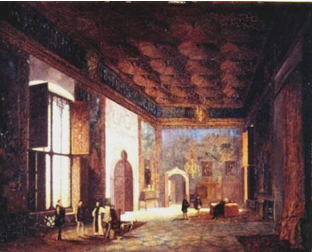 Interior of the Llegendes Room of the Palau de Mossén Sorell in València. Canvass by V. Poleró
The pavimento (floor) of the second largest space of the Sala La Nova (New Room) has a variety of ceramic tiles which are protected by a plastic sheet for their conservation. It is comprised by an extended rug enclosed by a border comprised by five rows of ceramic tiles. The external bands are comprised by several types of ceramic tiles and encase a central motif formed by a single type of decorative in a blue on white colour. This floor is original although several repairs have been observed with ceramic tiles from the same period and from the palace itself which recent documented discoveries situate in the 18th century.
The next room of this section was the winter salon, hence the existence of a chimney which is now covered with a pladur wall. In the upper section of this element, there is a huge mural with the commemoration of Nuño Pardo de la Casta who participated in the Battle of Lérida between Spain, Catalonia and France, in which he was seriously wounded and he sought shelter in Valencia at that time. In this space, he wished to record this event and his visit to the palace of his deceased father Luis, which belonged to his brother Joan at that time.
The floor has three different border bands, which enclose a white and blue ceramic tile with a geometric motif forming a large tapestry.
The last room of this section has a floor with the same composition and ceramic tiles as the previous space.
However the artesonado (coffered wood ceiling) is not the same; it is formed by hexagons in a rectangular section and with triangles in its square intersections which complete these geometric elements, as well as other decorative motifs of notches, diamond tips and cords.
The next room has a pavimento (floor) which does not have borders and the motif is composed based on hexagons formed by square ceramic tiles, trimmed to adjust them and combined by means of starry polygons or hexagons formed by rhomboid ceramic tiles with white, cobalt blue and green colours. They provide an optical effect of volume in several cases.
The artesonado (coffered ceiling) of this room is made of wood with 54 square casetones (coffered ceiling sections). This entire element is encased with moldura dentada (notched moulding), and each of them is delimited with puntas de diamantes (diamond tips).
The pavimento (floor) is comprised by two borders which encompass a large central tapestry. The first (with large dimensions) is executed by the combination of rhomboid ceramic tiles forming a braided motif, which is interrupted on the south and east sides. This braid is formed by rhomboids with a cobalt blue and manganese purple colour. It seems to be the only room which has a complete rhomboid border, exactly as it was originally installed. In the internal and external spaces of this braid design, the combination of rhomboid ceramic tiles corresponds to different models. There are several replaced sections which can be easily observed which correspond to the 20th century.
The artesonado (coffered wood ceiling) is comprised by 37 casetones romboidales (rhomboid coffered ceiling sections) and in this form’s interior, there is an encasing moldura dentada (notched moulding). Another type of decoration is the puntas de diamantes (diamond tips) which delimit and border the rhomboids, and in turn, create other geometric figures such as scalene triangles which in turn, form new rhomboids.
The last room has a floor with an initial border formed by two lines of ceramic tiles of a “mitadat” (split type). When four of them are joined, a rhomboid is created with a blue or green colour, although, the colours are mixed in several of them, since the border is not uniform and also does not follow a specific order. In the north and east sides of the room, the border is executed with two lines of square monochrome ceramic tiles in blue and white and others in the “mitadat” or split format with green-dark green colours.
The artesonado (coffered wood ceiling) of this small room is comprised by several simple casetones (coffered ceiling sections). The same as the above cases, notched mouldings and diamond tips were used as ornamental elements.
In the last room, there is a pequeña capilla (small chapel) covered by a bóveda (vault ceiling), which has used an esgrafiado (sgraffito) technique for a decoration with plant scrolls, diverse representations of birds and seraphim faces. The drawings have a white colour on a pink background. The similarity with the churches “sgraffito” decoration means that they correspond to the same time period at the end of the 17th century.
In reference to its floor, it is composed by a series of ceramic tiles with different types of flowers and plants on a white background. This entire set is encased with a border with two large flowers drawn in rectangular ceramic tiles. This representation has a white background where green, blue and yellow colours predominate.
- Click here for audio guide with sign language.
- Audio guide: