
QR10 Sala La Torre (The Tower Room)
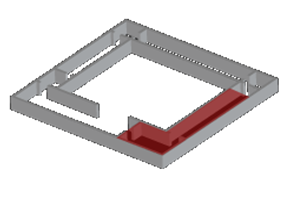 This room is located in the northeast mezzanine of the castell. The entry is framed with a stone arco en cortina (curtain arch) with slender attached columns, zoomorphic decoration and Medieval ornamental motifs.
On the left side of the room embedded in the wall, there is a chimney made of porous stone. On it, there is an engraved “escudos de armas” (heraldic coat of arms) which correspond to the noble families who formed a part of the Lordship of Alaquas. It is not the original element.
The artesonado (coffered wood ceiling) which covers all the spaces of the Tower Room are comprised by wood casetones (coffered ceiling sections) with the same style as those in the vestíbulo (Entry Hall).
The pavimento (floor) is comprised by rectangular fired clay tiles grouped in pairs and each one frames the heraldic ceramic tiles from the 16th century with the “Torres de Aguilar” family emblems. A blue colour on a white background was used for the drawing motif.
This entire scene is reinforced with a surrounding “zócalo” (skirting) with rectangular fired clay tiles and it features a composition of azulejos de estilo Mudéjar (ceramic tiles with a Mudejar style) from the 15th century, framed with wood moulds. Star shapes are the drawing motifs which characterise these ceramic tiles. Two shades of green and a brown colour on a white background where used as the profile of this geometric decoration.
In addition to these decorative elements, on the right side and in front of the room entry, there are two festejadors (courtship window seats). They are large windows with two stone seats which face each other.
–
Curious fact: The festejadors (courtship window seats) were designed to be used to converse face to face with a person or to do a task which required sunlight. The name of this element originates from the Valencian word festejar which is used to describe two people who are beginning a formal couple relationship. This space does not go unnoticed by the visitors.
–
The access to the second space of this room is through a wood door with a double hinge. This room has two large windows; under each one, there is a festejador (courtship window seats), a double one which has a view of the square and a single one which faces the cloister.
In its pavimento (floor), we find ceramic tiles from the 18th century, which were created with a “técnica a mano alzada” (freehand technique). It is comprised by an assembly of square terracotta floor tiles in a rhomboid position, and there is a ceramic tile with a decorative plant motif in the centre. This ornamental composition is comprised by two plant stems with criss-crossed diagonal leaves from which two pomegranates emerge. White was used as the background of this ceramic tile, and the drawing is outlined with manganese and a variety of green, dark brown and purple-black tones. The floor did not coincide with the monument’s construction.
The ceiling of this room is the same as the first one which we found in the main Tower Room, a coffered wood ceiling with simple square casetones (coffered ceiling sections), although less crafted.
This space has the same elements as the previous room, a festejador (courtship window seat) on each side laid out in the same way. The carpentry of the windows differs from the other rooms.
The artesonado (coffered wood ceiling) is the same as in the other rooms, with casetones (coffered ceiling sections) that are simpler than the one in the entry hall.
The floor has been renovated due to the comprehensive refurbishment works of the Monument in 2007.
The last space is divided into two sections, the largest one was the room and a hall was built in the other narrow space to connect it to another area. This room houses the Central Office of the Valencian Section of the Fundación Ernest Lluch (Ernest Lluch Foundation), IDECO (Institut d’Estudis Comarcals [Institute of District Studies]) and the Quaderns d’Investigación de Alaquàs (Alaquas Historical Investigation Magazine).
- Click here for audio guide with sign language.
- Audio guide: